What is an ideal education system?
This is a burning question that has been the centre of discussion for the longest time. Whether it is an outdated curriculum or ineffective instructional methodologies, institutes must strive to improve the academic structure. Therefore, NEP 2024 is a pivotal move towards fulfilling the objectives of the new educational policy announced a few years ago. Besides, it is a comprehensive policy that envisions a complete transformation of the existing education system.
What is NEP 2024?
NEP, or National Education Policy 2024, is a part of the National Educational Policy 2020 that envisions establishing a progressive and inclusive education system. It identifies the modern era’s requirements and learning needs and introduces necessary changes. Furthermore, holistic learning, digital literacy, and skill development are central components of the policy. Besides, one of the recent developments includes renaming the Ministry of Human Resource Management to the Ministry of Education.
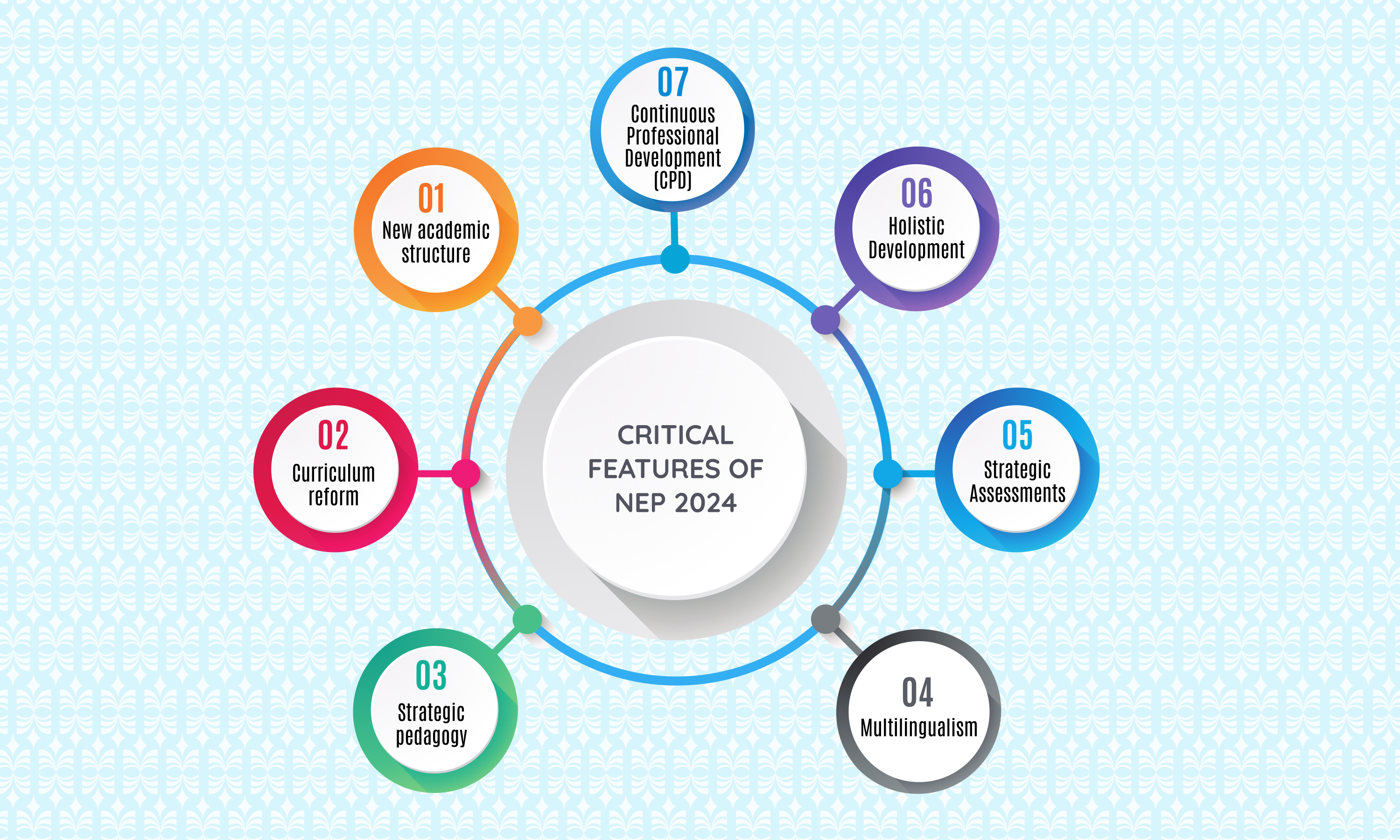
1. New Academic Structure
The Indian education system has been following the 10+2 system for the longest time, with a strict emphasis on the board exam. An exam-centric system, textbook-oriented teaching, and passive learning are notable aspects of the traditional education system. Hence, revamping the academic structure is one of the first steps, which will help establish the 5+3+3+4 Education System as follows:
- Foundational Stage:This is the first stage, which consists of five years, wherein schools will facilitate effective ECCE (earlychildhood care and education). Children will learn foundational numeracy and literacy skills through playful and engaging learning activities in the last two years of the stage.
- Preparatory Stage: Teachers will employ unique instructional strategies in this stage, which includes the 3rd, 4th, and 5th grades. They will discover new subjects and learn actively through a hands-on approach.
- Middle Stage: It includes the 6th, 7th, and 8th grades, wherein students will gather mastery of concepts in several subjects. Furthermore, teachers will conduct various activities, allowing students to foster their thinking abilities.
- Secondary Stage: This is the final stage of school education, wherein students will get the freedom to choose their subjects. The integration of vocational education will allow them to learn diverse skills and subjects simultaneously.
2. Curricular Reform
A revamped curricular structure will align with the new academic system and serve to enhance the learning experience throughout all stages. For instance, in the preparatory stage, children will read light textbooks and learn through play-based activities. As the students progress through the stages, they will engage in activities that will foster critical thinking and flexibility in subject choice. Also, they will be able to discover the intrinsic connection between different subjects.
Moreover, the reduction of curriculum content and emphasizing the core essentials is a notable aspect, giving space for analysis- based learning. Consequently, the content will focus on critical concepts, ideas, applications, and problem-solving. The classroom sessions will be interactive, enabling students to brainstorm, solve problems, explore, and draw conclusions. Also, collaborating with peers on projects and assignments will improve their socio-emotional skills.
3. Strategic Pedagogy
Moving beyond the constraints of conventional teaching methods and employing innovative pedagogical strategies is imperative. Therefore, the policy suggests a student-centric and inquiry-based approach to teaching and learning. Furthermore, institutes will employ an arts-integrated pedagogical approach that will follow experiential learning mechanisms. For example, teachers can conduct poetry, drawing or painting sessions, group plays, drama, etc.
In effect, it will inculcate Indian ethos in the teaching and learning process, helping to establish a link between education and culture. Simultaneously, sports-integrated pedagogy will be a part of teaching and learning by including various sports.
Consequently, it will help to develop essential skills such as self-discipline, self-direction, self-initiative, collaboration, etc. Also, it is a great way to teach teamwork, responsibility, and citizenship. Most importantly, it motivates students to adopt fitness as a lifelong attitude, helping to achieve the goals of the Fit India Movement.
4. Multilingualism
When children hear something in their native or mother tongue, they understand and respond faster to it. Therefore, NEP emphasises the utilisation of the mother tongue as the medium of instruction until at least Grade 5, but preferablyuntil Grade 8 and beyond. Public and private schools will implement the initiative and ensure bridging the gap existing between the student's mother tongue and the teaching language. Teachers will incorporate a bilingual approach, such as using bilingual teaching-learning materials.
Institutes will follow the three-language formula within the constitutional provisions and according to the people and region’s aspirations. Furthermore, the states, regions, and students will have the freedom to choose their ‘’three languages’’. Also, under the multilingualism initiative, students will learn Sanskrit and other classical languages such as Tamil, Telugu, Kannada, Malayalam, and Odia. Additionally, they can also learn a variety of foreign languages, such as Korean, Japanese, Thai, French, German, Spanish, Portuguese, and Russian.
Institutes will use innovative methods such as storytelling, films, theater, gamification, etc. to teach all languages.
5.Strategic Assessments
Summative and high-stakes examinations have been central to the traditional examination structure and are responsible for the exam-centric system. Hence, the policy aims to establish a more strategic assessment system. It emphasises creating formative and regular assessments, helping to assess students’ understanding and knowledge levels. Moreover, the examination system will undergo the following transformation:
- The education boards will redesign the board exams by making them easier and more purposeful and assessing core competencies and capabilities.
- Students will get two chances in a particular school year to take the board exams, helping to eliminate the high-stakes aspect.
- School assessments in Grades 3, 5, and 8 will assess students’s achievement of basic learning outcomes. Furthermore, these will focus on assessing core concepts and knowledge from the national and local curricula and higher-order skills.
- NEP proposes setting up the National Assessment Centre and PARAKH (Performance Assessment, Review, and Analysis of Knowledge for Holistic Development).
- PARAKH will serve as an authorised body that establishes norms, standards, and guidelines for assessing students.
6. Holistic Development
Education’s goal goes beyond ensuring the academic achievement of students and includes their social, emotional, and personal development. Therefore, a significant method of accomplishing the goal is through holistic development. Holistic development focuses on the overall development of students through multi-disciplinary, comprehensive, and outcome-based education. Henceforth, it calls for implementing well-planned and diverse methodologies.
Key Takeaways
NEP 2024 is a notable stepping stone towards affirming the visions and goals of National Educational Policy 2020. It states the major steps that institutes across the country can take to implement a competency-based education system. Moreover, it emphasises establishing a student-centric system wherein pedagogies will center around meeting learning needs.
Resources
- https://www.education.gov.in/sites/upload_files/mhrd/files/NEP_Final_English_0.pdf
- https://www.education.gov.in/nep/about-nep
- https://vakilsearch.com/blog/new-education-policy/
- https://english.jagran.com/education/new-national-education-policy-2024-navigating-challenges-embracing-opportunities-10156293
Disclaimer
The content of this article is based on information sourced from the official website of the Ministry of Education, Government of India. NEP 2020 is currently in the implementation phase, and the content of this article reflects the anticipated outcomes in the future. Please note that NEP 2024 is not a separate policy but part of NEP 2020. For more information, refer to the links below. Suryadhi Learning Pvt. Ltd is not responsible for any discrepancies, changes, or adherence to the guidelines presented.